I am a postdoctoral scholar at Oregon Health and Science University. As a member of the Cancer Early Detection Advanced Research Center in the Knight Cancer Institute, my research is focused on advancing technology capable of detecting cancer at its earliest stages, when treatment is most effective. My main research focus is on developing novel tools to isolate endogenous sub-cellular particles from complex liquid biopsy samples, including whole blood and plasma, by harnessing differences in the dielectric properties of the particles compared to their surrounding media. I also place a research emphasis on developing novel analytical tools to assess the captured particles when they are most concentrated. In addition to my research, I am also involved in various leadership and volunteering positions.
I am currently seeking academic faculty positions at institutions with a focus on hands on teaching through research and discussion. I am excited to help excite and train the next generation of scientists to seek creative solutions to solve the problems of tomorrow.
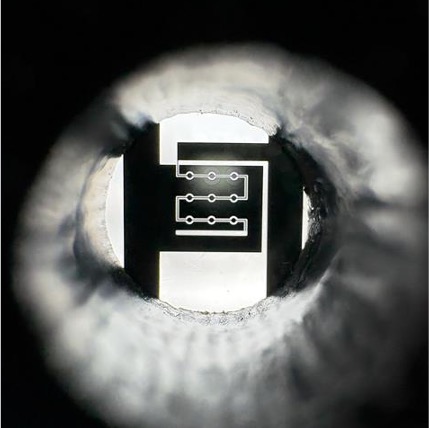
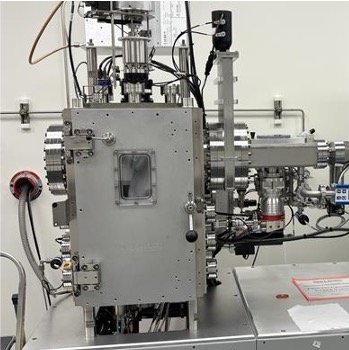
Utilizing cutting edge nanofabrication techniques, I fabricate novel sensors capable of isolating endogenous nanoparticles from complex liquid biopsy samples and quantify the presence of biomarkers of interest in a cost-effective manner. I focus on rapid prototyping, automation, and rigorous experimental validation with my background in analytical chemistry. I have in depth experience with clean room practices and maintenance, instrumental automation, machine learning, and synthetic chemistry.
My research harnesses differences in dielectric properties (the ability of charges to move around in response to an electric field) to separate particles in size range that is difficult with any other analytical technique. This process is termed "Dielectrophoresis" and has proven to be an effective method to isolate a wide range of micro and nano particles. However, this technique has seen limited use in high conductance samples such as blood as the voltage required to manipulate these particles would cause the sample to degrade. My work utilizes simulations to aide in designing microelectrodes which are capable of generating strong electric gradients at low voltages, allowing for effective isolation of nanoparticles from whole blood.
These devices enable nanoparticle diagnostics with a precision and simplicity that has never been done before. These devices enable the separation of complex mixtures in a matter of minutes from a single drop (~20 uL) of blood, while current standard practices require tens of milliliters and multiple days to accomplish the same isolation.
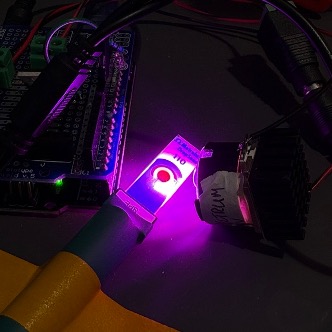
See the device in action:
I am grateful to have had opportunities to mentor researchers beginning their careers alongside my own. I have hosted four interns through the OHSU Center for Diversity and Inclusion Equity Research Program and the OHSU B-BRITE program. I also hired a part time undergraduate student worker to work year round on a project which I lead in the Knight Cancer Institute. I have worked with these positions to help make a career path and secure other prestigious internships and research experiences to advance their careers.
Under my supervision, one of my interns has published a peer reviewed manuscript isolating bacterial derived nanoparticles from plasma. Another intern received institutional recognition for the best summer intern poster.
Through serving as the OHSU Biomedical Engineering Society Chapter Treasurer, I was able to plan and execute a budget and plan events to advance camaraderie, professional development, and community outreach for other students in the program. I was also elected to served as the Graduate Student representative for the Cancer Early Detection Advanced Research Center Council, where I improved safety for researchers working after hours and developed improved feedback mechanism for research project teams.
I am also a project leader in CEDAR where I have secured over $200,000 in grant funding and lead a diverse team of faculty, graduate students, undergraduates, and engineers.

NASA Open Science 101
This certification was earned after completion of the NASA Open Science Curriculum which covers topics including when and how to share open source programs and data.
Teaching Science at University - University of Zurich (Coursera)
This course focused on how to communicate science to university students through course design centered on reframing conceptions and guiding students to take ownership of their learning and draw meaning extended beyond the course.
Training Future Faculty - OHSU (In Progress)
This course focused on how to effectively design lesson plans with an emphasis on backwards course design and student engagement. This course included observed teaching hours, lesson planning, and feedback from students and instructors.

Class 100 cleanroom fabrication techniques enable rapid development of sub-micron resolution devices for biological sensing techniques.

Manipulation and isolation of endogenous nanoparticles from complex biological samples by utilizing cutting edge electrokinetic methods.

Electrochemical analysis enables highly sensitive analytical techniques at a reasonable price-point, making diagnostic technology widely accessible.
Electrochemical Analysis of Dielectrophoresis Isolated Extracellular Vesicles from Undiluted Plasma to Identify Pancreatic Cancer, SCIX Conference, Innovation Awards Special Section, Covington, KY, October 9, 2025
Careers in academic research: Isolation and Quantification of Biological Nanoparticles , Portland Community College Bioscience Technology 181 guest speaker, Portland, OR, May 30, 2025
Electrokinetic Isolation and Electrochemical Quantification for Cancer Diagnostics, University of Portland Chemistry Department Guest Speaker, March 25, 2024.
Preparing for Your Qualifying Exam Oral Presentation, OHSU Biomedical Engineering Department, invited by department chair
Invited Terms:
- Winter 2023
- Spring 2024
Peer-Reviewed Manuscripts:
Stimson E, Shea D, Gomes M, Ware JP, Armstrong R, Ranganathan S, Heller M, Ibsen S, “Utilizing Two Electrokinetic Techniques on a Single Device for Detection of Extracellular Vesicle-Associated Protease Activity.” (2025) Small.doi:10.1002/smll.202404457
Fanizza A, Bollis N, Ware JP, Urnezius E, Piacentino EL, Gilbert TL, Ryzhov V. “Dehydrogenation of formic acid by first-row transition-metal/crown ether complexes studied by mass spectrometry and theoretical calculations.” International Journal of Mass Spectrometry. (2025) 508. doi: 10.1016/j.ijms.2024.117391
Ware JP, Shea DK, Nicholas SL, Stimson EA, Riesterer JL, Ibsen SD. “Recovery and Analysis of Bacterial Membrane Vesicle Nanoparticles from Human Plasma Using Dielectrophoresis.” Biosensors. (2024) Sep 25;14(10):456.doi:10.3390/bios14100456. PMID: 39451671; PMCID: PMC11505931.
Ware JP, Shea D, Youn Lim J, Malakian A, Armstrong R, Pethig R, Ibsen S; “Collection of Serum AlbuminNanoparticles from Human Plasma by Dielectrophoresis.” Electrophoresis. (2024) 45, 19-20: 1748-1763. doi:10.1002/elps.202400046
Luna R, Heineck D, Pablo Hinestrosa J, Dobrovolskia I, Hamilton S, Malakian Anna, Gustafson KT, Huynh KT, Kim S, Ware JP, Stimson E, Schutt Ibsen C, Ibsen SD. “Enhancement of Dielectrophoresis-Based Particle Collection from High Conducting Fluids Due to Partial Electrode Insulation.” Electrophoresis.(2023) 44, 15-16, 1234-1246, doi:10.1002/elps.202200295
Book Chapters:
Delaney Shea, Jason Ware, Michael Henderson, Ella Stimson, Mehrzad Sasanpour, Sarah Mitchell, Christian Rossa, Shelby Nicholasa, Stuart D. Ibsen. “The Use of Dielectrophoresis to Recover Cancer-Derived Nanoparticles from Undiluted Human Plasma for Cancer Detection Applications”, Emerging Technologies for Cancer Detection and Diagnosis, National Cancer Institute. (In Press)
Manuscripts In Review
Ware JP, Nicholas SL, Ross CW, Tao K, Riesterer JL, Olson S, Jensen G, Stimson EA, Ibsen SD; Distinguishing Pancreatic Cancer from Benign Pancreatic Disease via Electrochemical Quantification of Dielectrophoresis Isolated Nanoparticles from Clinical Plasma Samples. Invited Submission to Nature Biomedical Engineering.
Malakian A, Modestino A, Bueno J, Machireddy A, Hamilton S, Stimson E, Saldivar JC, Gustafson KT, Shea D, Ware JP, Keith D, Lippman S, Song X, Lim J, Sears R, Morgan T, Heller M, Ibsen SD; Liquid Biopsy Differentiation of Pancreatic Cancer from Non-Cancerous Disease Using Dielectrophoresis-Recovered Multiomic Nanoparticles. Submitted revisions to Small.
Helms H, Oyama K, Ware JP, Ibsen S, Bertassoni L. Multiplex Single-Cell Bioprinting for Engineering of Heterogeneous Tissue Constructs with Subcellular Spatial Resolution. Submitted to Advanced Materials Technology, February 2025(Preprint on Bioxiv)
Following are publications for which I designed the front cover journal art.
Scientific illustration connects authors with their projects on a deeper level and helps to communicate the main focus of the project in a more accessible medium that enhances the impact of the corresponding scientific literature.

The artwork depicts two circular microelectrodes showing the formation of hydrogel domes which enhance the electric field gradient of the system. Depicting electric fields in an artistic manner is notoriously difficult. Here, I tried to capture the electric field in the style of the aurora borealis. Structures were generated in Autodesk Fusion 360, additional details were added in the GNU Image Manipulation Program.

The artwork depicts depicts smaller single molecule proteins of serum albumin diffusing in the upper background, while the larger aggregates of albumin proteins experience a significantly stronger dielectrophoresis force and are pulled down onto the electrode surface. This cover was inspired by a meteor shower, with the large glass-marble looking aggregates plummeting to the electrode surface. The basic geometry was designed and rendered in Fusion 360, and final processing was performed in Adobe photoshop.